

Five Weeks Without Hormuz
Global plumbing reworked in real time
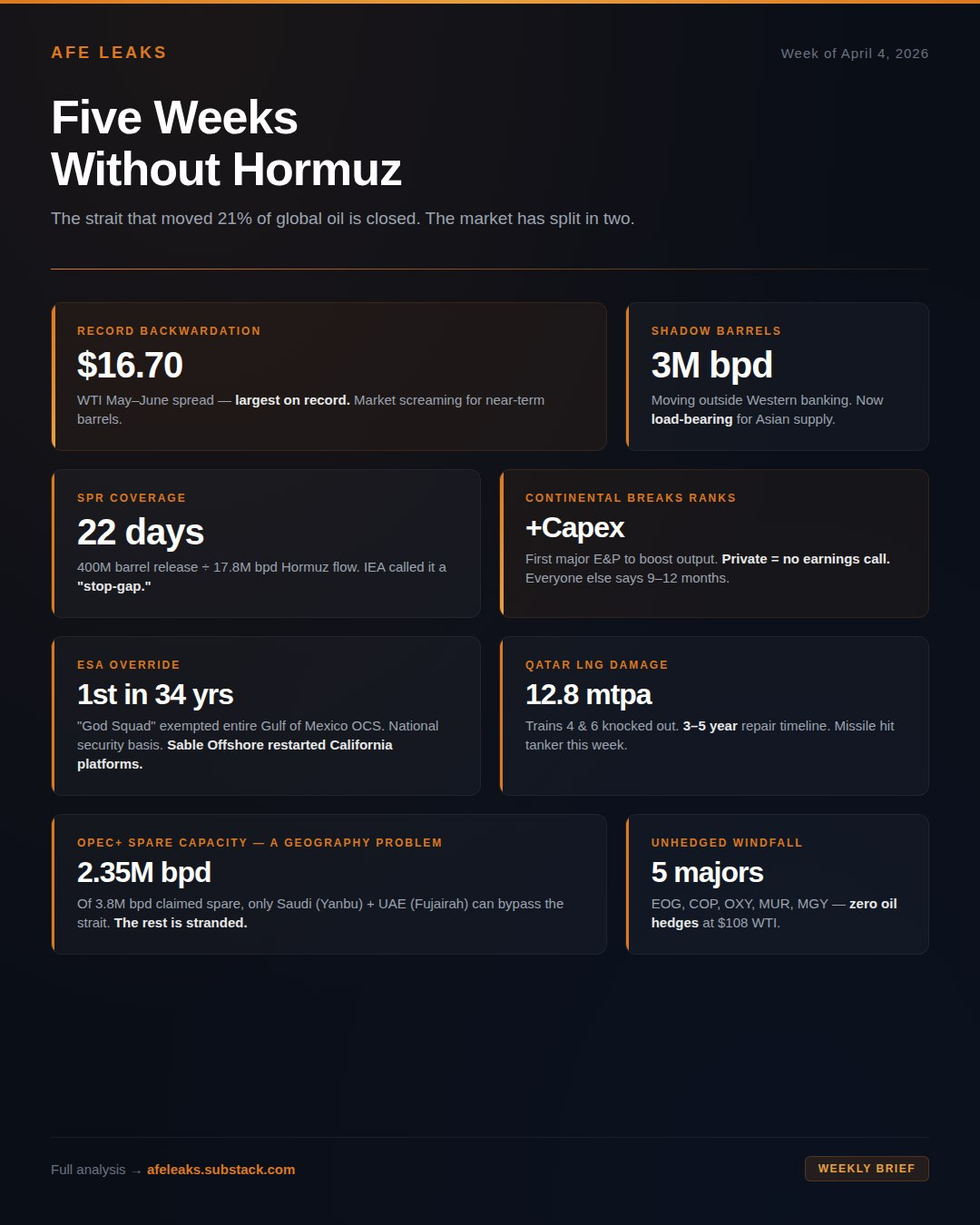
The IEA called it "the biggest disruption in history." Five weeks since U.S. and Israeli strikes shut down the Strait of Hormuz, more than 12 million barrels of net crude supply have been lost, per IEA estimates. A cruise missile hit a QatarEnergy tanker this week. Trains 4 and 6 at Qatar's LNG complex — 12.8 million tonnes per annum out of Qatar's roughly 77-million-tonne capacity — are damaged and won't be back for three to five years. Iran is drafting a Hormuz transit protocol with Oman that would require shippers to pay tolls. The UAE has appealed to the UN to authorize force to reopen the strait.
Meanwhile, WTI May futures traded $16.70 above June — the largest backwardation on record, a market screaming for barrels right now. European diesel topped $200 per barrel for the first time since 2022. International propane surged 58% since February 28. U.S. fuel exports hit a record in March as Asia and Europe scrambled to replace Middle Eastern supply.
That is the visible crisis. Underneath it, a series of quieter adaptations are reshaping who produces oil, how it moves, and under what legal authority.
The Parallel Pipeline
Asian refineries haven't stopped running. The barrels are still flowing — through infrastructure that was built for sanctions evasion and is now load-bearing.
China imported 11.1 million barrels per day in 2024. Iran supplied 11% of that — roughly 1.2 million barrels per day — and the EIA confirms about 90% went to independent teapot refiners in Shandong. OFAC has documented the mechanics: ship-to-ship transfers into tankers delivering to Shandong-linked buyers. China also imported 1.4 million barrels per day from "Malaysia" last year, though Malaysia only produces 600,000. The gap is widely understood to be relabeled Iranian crude.
India's channel works differently. Russian crude — which went from 2.5% of India's imports in fiscal 2021 to 36% in fiscal 2025 — moves primarily through UAE traders and settles in dirhams. S&P Global data shows Russian shipments averaged 1.67 million barrels per day in the first half of 2025, though they fell to 1.14 million by January 2026 after state refiners paused purchases under diplomatic pressure.
Adding China's 1.2 million barrels per day of Iranian crude, roughly 800,000 barrels per day of relabeled Malaysian imports, and India's 1.1 million-plus from Russia, a conservative floor of 3 million barrels per day now moves outside Western banking and insurance channels. With Hormuz closed, this is the primary supply chain for the world's two largest crude importers.
The SPR Buys Time. That's It.
The IEA's coordinated release — 400 million barrels across member nations, 2.2 times larger than 2022 — covers 22 days of normal Hormuz flow. The U.S. share is 172 million barrels over roughly 120 days, which will draw the SPR to approximately 244 million barrels — the lowest since the early 1980s.
Treasury estimated the 2022 release lowered retail gasoline by $0.17 to $0.42 per gallon. The NBER found that a 10-million-barrel surprise release cuts spot prices 2-3% temporarily. Scale matters, but so does duration. The IEA itself labeled this one a "stop-gap." Every barrel released now is unavailable for whatever comes next. And the strait isn't reopening on a schedule.
OPEC+ Spare Capacity Is a Geography Problem
OPEC+ claims 3.8 million barrels per day of spare capacity. The problem is geography: most of it is stranded behind the closed strait. Saudi Arabia can redirect crude via its East-West Pipeline to Yanbu on the Red Sea. UAE exports from Fujairah, also outside Hormuz. Those are the only two producers whose spare barrels can physically reach Asian buyers — holding a combined 2.35 million barrels per day of capacity between them. The rest is stranded by geography. Separately, some of it doesn't exist at all: Russia is already producing 1.02 million barrels per day below its own quota. Adding paper barrels to a country that can't fill its current allocation doesn't solve either problem.
The Legal Ground Shifted
On March 31, the Endangered Species Act "God Squad" — a cabinet-level committee that hadn't granted an exemption since 1992 — exempted the entire Gulf of Mexico federal offshore from the ESA. Defense Secretary Hegseth cited the Iran war and national security. The exemption covers all federal outer continental shelf oil and gas activity. Fewer than 100 Rice's whales remain in the Gulf. Environmental groups have already filed suit.
This isn't an incremental permitting change. It's the first national-security ESA override in 34 years, and it applies to an entire basin. The legal framework for Gulf offshore just fundamentally changed.
The broader pattern is wartime scarcity widening the political aperture for offshore supply — not just in the Gulf. Within days, Sable Offshore filed an 8-K reporting first oil sales from the Santa Ynez Pipeline System — a California offshore restart. Platform Harmony is producing roughly 22,000 gross barrels per day. The pipeline filled at a rate exceeding 50,000 barrels per day. Platform Heritage passed its final BSEE pre-restart inspection, with restart commencing at 30,000-plus gross barrels per day. Platform Hondo is expected online by end of Q2 at another 10,000-plus. Sales are going to Chevron.
California offshore oil production coming back online. A year ago that sentence would have been fiction. And legal challenges could still make it so.
Who's Actually Responding
Continental Resources became, by our tracking, the first major E&P to publicly commit to boosting output this week. CEO Doug Lawler: "Continental is increasing our capital budget, which will increase production." The company produces 475,000 barrels of oil equivalent per day across the Bakken and Permian and had previously budgeted $2.5 billion in capex — a 20% cut from 2025. Harold Hamm's company is private, which means no quarterly earnings call and no activist investor demanding capital returns. Continental can respond to $108 oil the way public operators used to.
The rest of the production response, if it comes, won't be fast. ConocoPhillips said at CERAWeek that even if prices hold, new barrels need six to twelve months. "Nine months is best-case scenario," per Nick Olds. Admiral Permian Resources, running two rigs at 25,000 barrels per day, said they'd need six to twelve months of consistently high prices. Citi estimated that if prices sustain, public producers could add about 20 rigs and privates about 47 — enough for roughly 815,000 barrels per day through 2028. That's a 2028 story, not an April one.
Meanwhile, five major operators — EOG, ConocoPhillips, Occidental, Murphy Oil, and Magnolia — entered 2026 with zero oil hedges. At $108 WTI, every unhedged barrel is a huge windfall.
The Infrastructure Buildout
Two other filings this week point to where the structural investment is going.
Atlas Energy Solutions signed a 5-year power purchase agreement with a "technology infrastructure provider" — almost certainly a data center — to develop a power facility in the Permian Basin. This follows Chevron's exclusive partnership with Microsoft and Engine No. 1 on a 2.5-gigawatt gas-fired power plant in West Texas, scalable to 5 gigawatts, estimated at $7 billion. That's the largest Big Oil–Big Tech collaboration to date and could come online by late 2027.
And on the gas side, 4.5 billion cubic feet per day of new Permian pipeline capacity is slated for the second half of 2026 — RBN Energy's "tale of two halves" for Waha pricing. The Haynesville has nearly doubled its rig count year-over-year to 56 rigs. Comstock is doubling its Western Haynesville wells to 24 in 2026 from 12 in 2025.
The capital isn't chasing $108 oil. It's chasing gas-fired power demand that will outlast any geopolitical premium.
The Week's Filings
A few more from the 8-K stack:
Devon and Coterra both filed 8-Ks confirming the HSR antitrust waiting period for their merger expired April 1. Closing is expected in Q2, subject to shareholder votes. The combined company will be a multi-basin Permian-scale operator.
Transocean announced $1 billion in new deepwater drilling contracts: the Transocean Barents to Vår Energi in Norway at $450,000 per day for three years, plus extensions with Petrobras in Brazil for the Deepwater Orion and Deepwater Aquila. Deepwater dayrates are climbing.
Liberty Energy launched a $450 million convertible notes offering. Tamboran Resources filed on a Beetaloo Basin farm-in with staged earn-ins up to $2 billion-plus. Capital is moving — just not always where the headline rig count tracks it.
Where This Leaves the Market
Five weeks in, the Hormuz closure has split the oil market into two systems. The visible one — NYMEX, ICE, OPEC+ communiques, SPR releases — says spare capacity exists and reserves are being deployed. The invisible one — Shandong teapots, dark fleet tankers, UAE dirham settlements — says 3 million barrels per day of Asian supply depends on infrastructure that was never designed to be permanent.
The IEA's SPR covers 22 days. QatarEnergy's LNG damage will take years to repair. The ESA exemption suggests Washington is planning for a prolonged disruption. Continental broke ranks. And the forward curve still collapses to $80 by Q3 — which is why public operators are sitting on their hands while the physical market is the tightest it's been since the 1970s.
The gap between paper and physical is the story of this market. It has been for five weeks. It's getting wider.
Sources: IEA emergency coordination (March 2026); EIA China Country Analysis 2025; OFAC press releases (sb0090, sb0135); Columbia CGEP; S&P Global Commodity Insights via LiveMint; Baker Hughes rig count Apr 3; OPEC Monthly Oil Market Report; SEC 8-K filings: SOC (Mar 30), DVN/CTRA (Apr 2), RIG (Apr 2), AESI (Apr 1), LBRT (Mar 30), TBN (Apr 3); Continental Resources via World Oil/Hart Energy; COP/Admiral Permian per Reuters (CERAWeek); Citi Research (Mar 27); RBN Energy; Hart Energy; Rigzone; Reuters commodity pricing Apr 2-3, 2026; Treasury/NBER (2022 SPR analysis).
AFE Leaks provides independent upstream oil and gas research. Nothing here is investment advice. Do your own work.